
The first time I opened the door of that club, I thought I had walked into a space shuttle.
Ocean view. Machines I had never seen before, the kind you see in magazines and never in a real gym. Everything looked like it came from another world. My first thought was simple: I want to be part of this.
Then we opened the numbers.
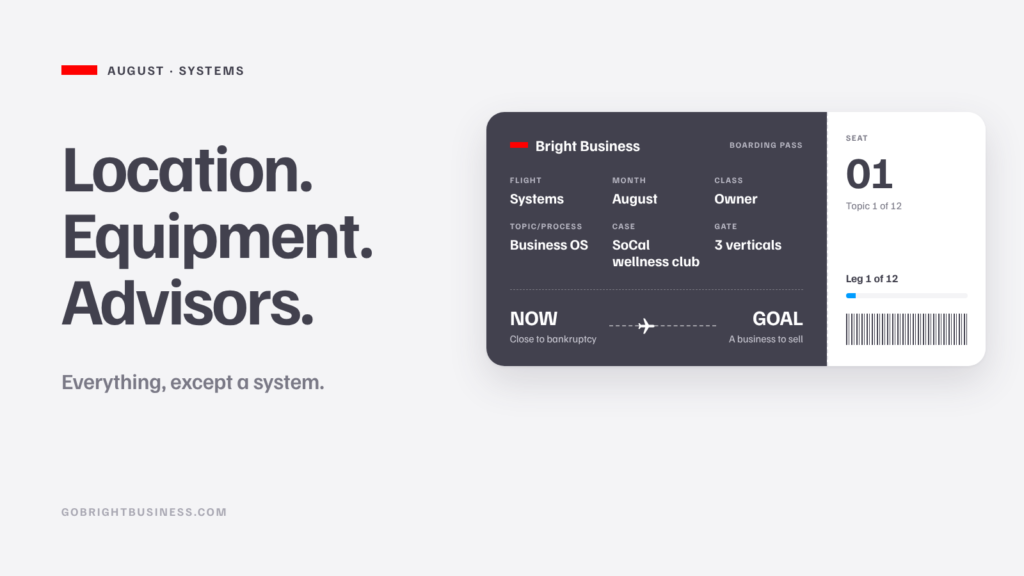
This is a real client story from my own work, before Bright Business existed in its current form. The names and some details are changed to protect the family. This was August’s topic/process at Bright Business, Systems, and the story behind why we start every year with it.
The painA recipe for success, two years from bankruptcy
Ryan and Claire are a husband and wife with two kids, nine and ten years old at the time. Wonderful family. They put all their savings into one dream: a premium wellness club in a high-end neighborhood on the Southern California coast. On top of the savings, they took on a loan secured against what they owned.
They did everything you are told to do. The best location money could find. The best equipment money could lease. A business advisory firm to guide the strategy and a marketing agency to fill the floor. The club won awards. On paper, it was a recipe for success.
Two years later, cash flow was falling, members were leaving faster than they joined, and the family was close to losing everything they had put on the line. The stress, the conflict and the burnout came home every night. And nobody, not the owners and not the experts, could say why it was happening.
Everyone was waiting for a miracle. That word was what made me stay.
The factThe clock most owners never see
According to the U.S. Bureau of Labor Statistics, about one in five new private-sector businesses closes within its first year, and only about half are still open five years later.1 Most new owners spend those first years running on their own savings, trusting that the plan will work before the money runs out.
Ryan and Claire were two years in, on their own savings, and the clock was loud.
The auditTwo weeks, and two questions nobody could answer
I came in to help with marketing and sales. For two weeks I lived in that club. I talked with members on the floor and with the staff at the front desk. I went through every campaign. I sat down with the marketing agency and tried to talk with the advisory firm.
I kept asking two basic questions. Who is the ideal customer for this club? And what is its purpose, the why behind it? Nobody could answer. Not clearly. Not in one sentence.
I wasn’t welcome in that mix. The experts had their plan, and a marketing person asking about purpose looked like someone who didn’t know his place. Honestly, I started to believe it myself. I felt unqualified and in the way, and I was ready to leave.
Before I did, I asked Ryan and Claire for one last conversation. I told them what I believed: you cannot design a single campaign until you understand the business model, the pain you solve, and the why behind all of it. A new logo won’t fix a business that doesn’t know who it is for.
That conversation got personal, and it changed the room. They stopped expecting deliverables from me and agreed to step back and look at the whole picture together, starting with themselves.
The patternWhen everyone tells you what you want to hear
Here is what I learned in those weeks, and I see it in many businesses since.
Ryan and Claire had never owned a business before. Their backgrounds were in insurance and fitness, and running a business is a different skill altogether. So they did what new owners do: they trusted the experts and stopped asking questions. Experience helps here, and they had none to lean on. Their advisors were good professionals, but they were employees, not owners. A consultant and an account manager can be excellent at what they do and still never have had to make payroll from their own savings. No one in that circle was a peer: another owner who had sat in the same chair and could say the hard thing.
The advice they got was encouraging. It spoke to their pride: the most beautiful club, the most advanced machines, the awards. Negative voices are easy to spot and easy to ignore. Encouraging voices that point you the wrong way are the most dangerous ones, because they feel like support. Accountability to the wrong journey only gets you lost faster.
The spiralFrom premium to price cuts
When I stood on the floor and looked around, the picture didn’t fit. Very wealthy members on one side. On the other, people who would have felt more at home in a raw, heavy-lifting gym. Two crowds that didn’t mix.
The numbers explained how it happened. The club opened as a premium brand with a premium price, and it started strong. When sales dipped, the price came down. A different crowd came in, and the premium members felt less comfortable. Sales dipped again, the price came down again, and the mix got worse. Meanwhile the money kept going into upgrades, hoping the right people would come back.
The premium members didn’t complain. They quietly quit. When I talked with them, I understood why. Many were seniors. Some of the machines were so advanced that even I struggled to use them. And most of them weren’t there for the machines at all. They came for the people, to see friends, to belong somewhere.
Inside the business, the story was different: the members don’t appreciate what we built for them. When a business starts blaming its customers, the cause is almost never the customers.
The systemThree verticals, from the symptom to the root
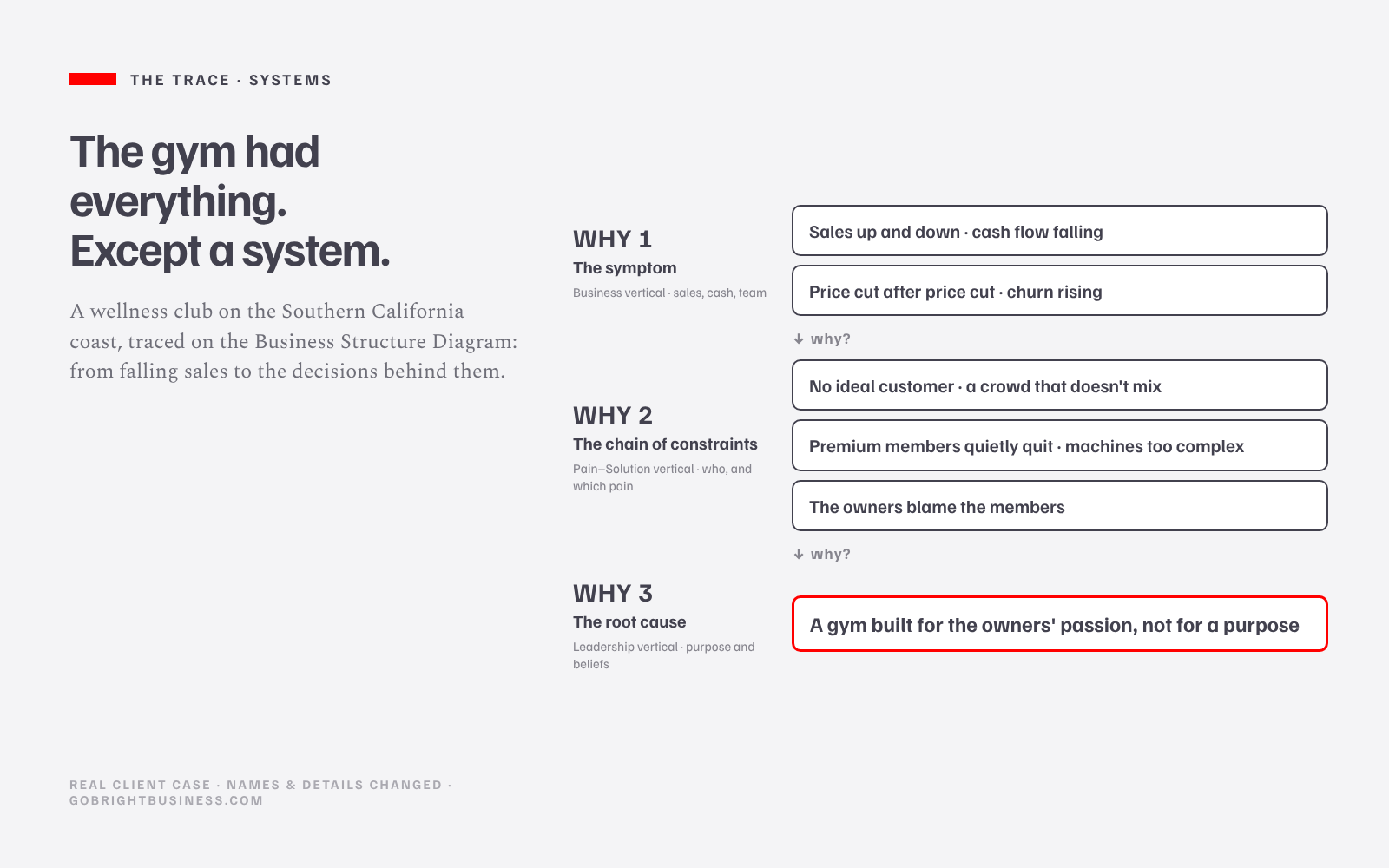
This is when I drew the diagram that later became the Business Structure Diagram, the map at the center of the Bright Business Operating System. A business is not a set of separate departments. It is an operating system: every part is connected, and every decision moves the whole thing. The diagram has three verticals, and we walked through them together, from the symptom everyone could see to the root nobody wanted to see.
The symptom · Business vertical. Sales up and down, cash flow falling, price cut after price cut, churn rising. This is where everyone was looking, and where every fix had been tried.
The constraints · Pain–Solution vertical. No ideal customer, so no clear message, so a crowd that didn’t mix. Premium members leaving over machines that were too complex. Owners blaming the members.
The root · Leadership vertical. Ryan and Claire had built a gym for themselves. It came from passion, a beautiful and genuine love for that space, but passion is not a purpose. A purpose is about serving others. What they had built was really a private dream: the club they would want, where friends could visit. Then they put all their money and all their hopes into turning that dream into a business. That is how a dream becomes a nightmare.
That was the hardest moment in the whole engagement. The cause of the struggle wasn’t the market, the members or the agencies. It was the quality of the decisions, starting from the very first one. And that is true for most of us. As owners, we are usually the ones who put our own business in trouble. The good news is that it also means we are the ones who can get it out.
The rebuildRewiring the system, one vertical at a time
Leadership first. Ryan and Claire rewired the way they decide. They learned to question everything, including the experts and including themselves, and to look at the club as a system of processes instead of a showroom. They wrote their purpose down. It was no longer “the club we love.” It was “we are here to serve our members.”
Then Pain–Solution: who are we serving, and which pain? The coast is not short of gyms. What it was short of was a place built for seniors who want to stay well and stay connected. That was the real pain, and the real opportunity. Older adults are also one of the growing parts of the fitness market: the Health & Fitness Association reported that members aged 65 and over grew 8.6% in a single year.2 With the ideal customer clear, we mapped the customer journey on purpose: how someone discovers the club, why they join, why they stay, and how a happy member becomes an ambassador who brings their friends.
Then Business: the business model. How the club creates value, delivers it, and captures it. We looked hard at the numbers: fixed costs, overhead, and what was draining the cash. Once we knew what members actually needed, the decisions got easy. We renegotiated the equipment lease and brought in simpler, less expensive machines. The money went into people instead: better trainers, and more attention to how they welcome and engage every member.
The seniors on that coast had the money, and they were happy to spend it. On quality time, not quality machines.
The methodThe 2×2 Human-Centered Matrix
To turn the new picture into action, we worked it on what I now call the 2×2 Human-Centered Matrix: four questions in a fixed order, with people at the center.
WHY · Where are we now, and why leave? Close to bankruptcy, cash flow down, churn high, prices cut again and again. Staying here was not an option. If nothing changed, the whole family would pay for it, and so would the team.
WHERE · What is the new reality? A business someone would want to buy. Break-even first, then steady profit, low churn, and members who bring their friends.
HOW · What is the strategy? “Increase sales” is not a strategy. With critical, analytical and creative thinking, we built a new business model: a senior wellness club built around community. From that, the rebrand and the communication almost wrote themselves: the right message, for the right people, to trigger the right behavior.
WHAT · What is the action plan?
- Renegotiate the equipment lease and replace the complex machines with simpler ones.
- Invest in trainers and in the human side of every visit.
- Rebrand and rebuild the communication around seniors and community.
- Win back former members and turn the happiest ones into ambassadors.
WHO · Who owns it? Ryan and Claire first, because their behavior had to change before anything else could. Then the stakeholders who believed in the new direction, including some of the wealthiest members, who had been looking for exactly this kind of club.
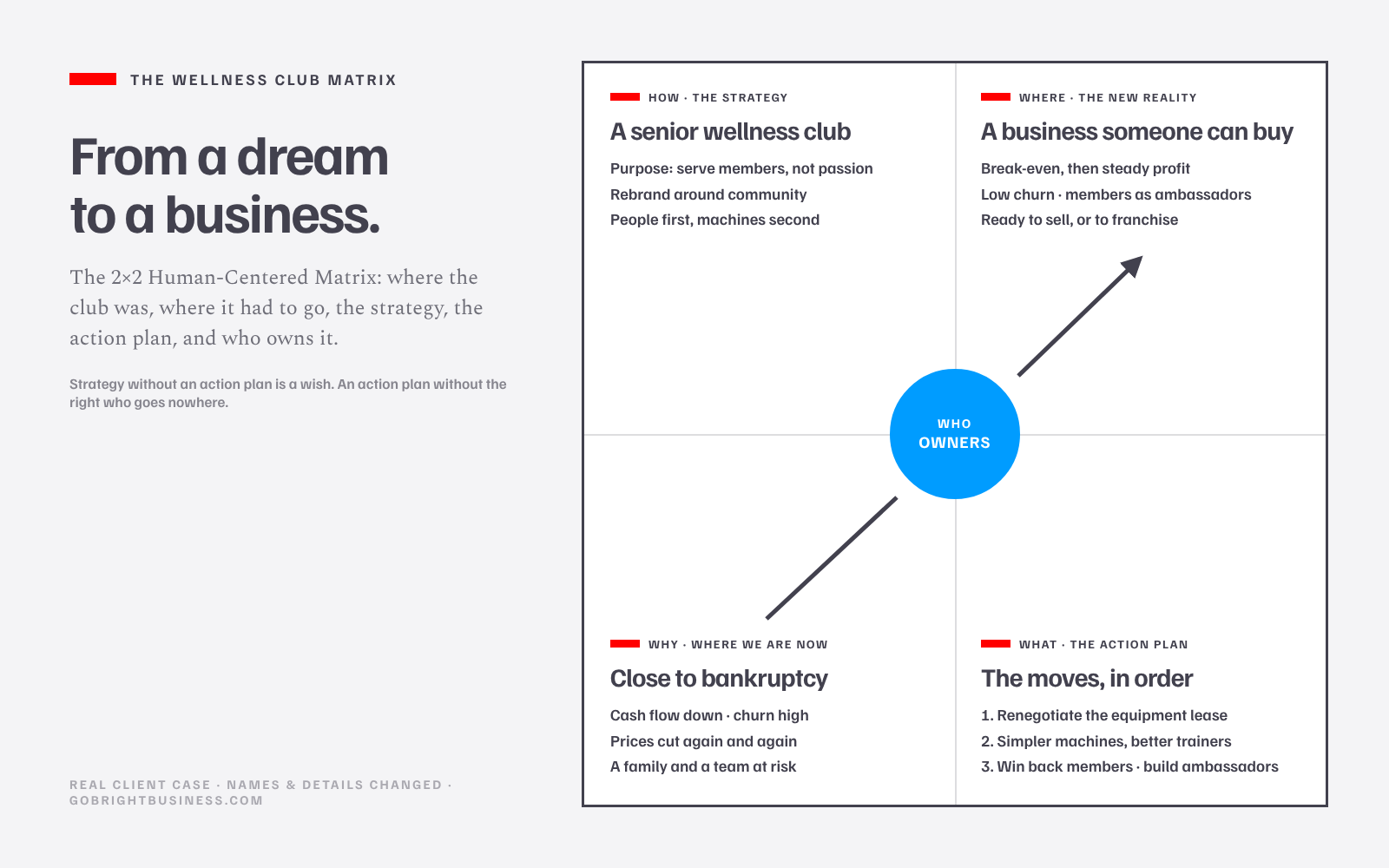
Imagine any one of those pieces missing. A strategy with no action plan is a wish. An action plan with no strategy is busywork. And a strategy and a plan without the right people at the center go nowhere. It takes all four.
The turnFrom the red to a business someone wanted to buy
It didn’t happen overnight. But step by step, within about six months, the club moved from the edge of bankruptcy to break-even, and then to steady profit for the first time since it opened.
Former members came back. New ones came with their friends. Churn dropped, retention rose, and the club started to build real brand equity, because it finally knew who it was for.
Before, Ryan and Claire had tried for over a year to find a buyer, with no luck. Now they had a business model, numbers that made sense and a story a buyer could believe. Finding a buyer became easy. There was even interest in turning the concept into a franchise. The goodwill on the table, and the multiple a buyer was willing to pay, changed dramatically.
The family avoided foreclosure. They avoided bankruptcy. And they were able to move on with their lives.
Before and afterWhat changed when the system was clear
| Before | After | |
|---|---|---|
| Purpose | A club built for the owners’ passion | A club built to serve its members |
| Customer | Anyone, at a falling price | Seniors who want wellness and community |
| Spending | Advanced leased machines, rising overhead | Simpler machines, money invested in trainers |
| Members | Premium members quietly quitting | Former members back, ambassadors bringing friends |
| Cash | Close to bankruptcy | Break-even in about six months, then steady profit |
| Exit | No buyer after more than a year | A buyer, franchise interest, a much higher valuation |
Real client case. Names and some details changed; outcomes described as they happened, without exact figures.
The lessonBusiness is its own skill
Entrepreneurship is not just doing something you love. Running a business is a skill of its own, and it starts with leadership: critical thinking, analytical thinking, design thinking and creative thinking, and the discipline to keep asking questions until the answers are true.
A business is a chain. Every process is a link, and every link is connected to the others. Sometimes the constraints are hard to see, and they show up as friction between people and departments. When the links are aligned, the business holds, even when you have to make tough decisions. To make those decisions, you need to see the whole system, and you need to be able to say why you are doing what you are doing.
That is why we start every Bright Business year in August with Systems. When you learn to move from the symptom to the root cause, you stop cutting prices to fix a purpose. You stop blaming, and start treating every struggle as a challenge you can solve, beginning with the question: which of my decisions needs to improve? Gut and inner voice still matter. They just work far better when you can see the whole picture.
And you don’t make those decisions alone, or only with people who are paid to agree with you. You make them with peers who have sat in the same chair.
The year so farWhere this fits in the Bright Business curriculum
Every month, the Clubs work on one topic/process from the Bright Business Operating System. Over twelve months, the whole business gets built, piece by piece.
- August · Systems. The business as an operating system: the Business Structure Diagram and its three verticals. This story.
- September · Processes. From strategy to action plan, and how a process becomes repeatable, scalable and delegable.
- October · Purpose. The why behind the business. Read Sam’s story: Why is my business competing on price?
- November · Inner-Leadership. The leader behind the business: how you think, and who influences your decisions.
If you missed the start of the year, you haven’t missed the system. Every topic/process connects back to the same diagram.
Your turnFive questions to see your business as a system
- What is the symptom everyone in my business is talking about right now?
- What have we already tried to fix it, and what did it cost?
- Can I name my ideal customer, and the real pain we solve for them, in one sentence?
- Did I build this business for my customers, or for myself?
- Whose advice am I following without questioning it, and have they ever owned a business?
See your business as a system. Pick the room that fits you.
Your first Club visit is complimentary.
Florin Diumea, Bright Business · Stay Bright.
Sources
- U.S. Bureau of Labor Statistics, Business Employment Dynamics, Table 7: Survival of private sector establishments by opening year (establishments opened in March 2019: 79.2% survived one year, 51.5% survived five years).
- Health & Fitness Association, 2026 U.S. Health & Fitness Consumer Report: Headline Trends (April 2026).