
It was 9:40 on a Tuesday night, and Sam was still sitting in his truck in the company yard, engine off.
That afternoon Marcus, his sales lead, had won a bid by cutting the price 12%. An hour later Rosa, his operations manager, walked into his office and told him the crew would lose money on that job. Then marketing got pulled into it, and the three of them started arguing about whose fault the slow quarter was. Sam ended it the way he always did. He made the call himself.
Now the yard was dark and he couldn’t make himself drive home. On his phone, the same line on the Bright Brain dashboard that had been red for three weeks was still red. He had looked past it every morning. Tonight he didn’t have anything left to look past it with.
If you own a business, you probably know that seat.
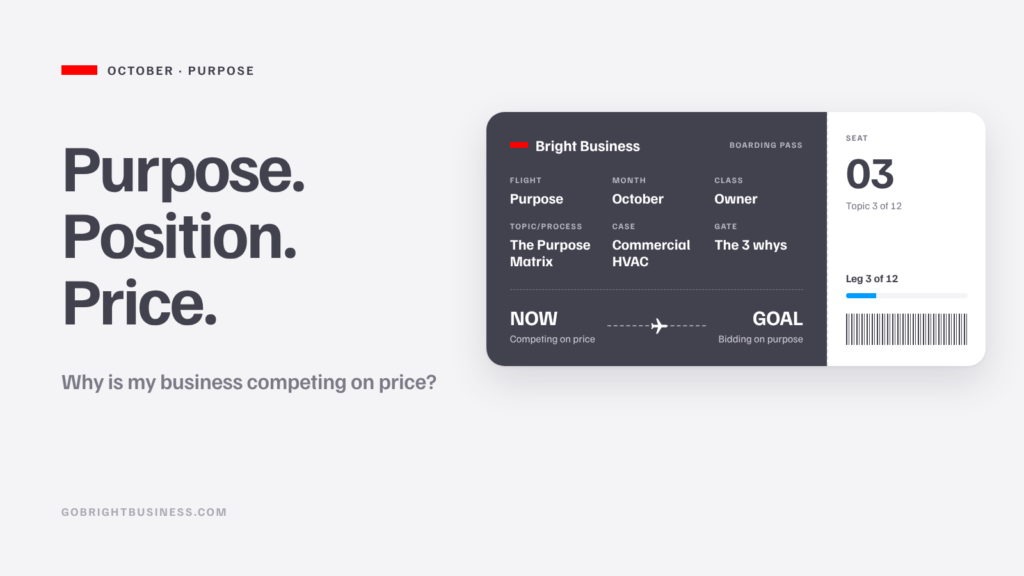
Sam and Coastline Mechanical are a composite teaching case, built from situations we see in our Clubs all the time. The names are fictional; the pattern is not. This month’s topic/process at Bright Business is Purpose, and this is the story we worked on in the room.
Following the year from the start? Our curriculum began in August with Systems: the business as an operating system. Read that story first: The gym that had everything, except a system.
The painFourteen years of building, and it starts to slide
Sam started Coastline Mechanical fourteen years ago with one van and a reputation. He was the HVAC technician people called when nobody else could fix it, and he picked up the phone at any hour. One client became five. Five became a company: commercial HVAC service and installation across San Diego County, 22 people, about $3.4M a year in revenue.
He built all of it step by step, winning client after client. What he never did was stop and write down why those clients kept choosing him. He didn’t need to. He knew. And every important decision still went through him, the way it had in the early years.
Then the numbers turned. Revenue fell 11% over two quarters. The win rate on bids dropped to 22%. About 60% of the bids were going to customers who were shopping on price, and maintenance contracts, the steady income, were only 18% of revenue.
Sam did what owners do. He pushed harder. More pressure on sales, so Marcus cut prices to keep the crews busy. More pressure on marketing, and marketing answered honestly: “We don’t have a differentiator. What do you want me to say?” Rosa’s team absorbed the low-margin jobs and got tired. Everyone was working. Nobody was wrong. And 22 people, and their families, were counting on Sam to know what to do next. He didn’t.
The factPrice is the most expensive way to win
Sam didn’t know the research, but he was living it. McKinsey’s pricing work found that for an average S&P 1500 company, a price rise of just 1%, with volume held steady, would lift operating profit by about 8%.1 The same lever works in reverse. Every point of price you give away to win a bid comes out of profit, not out of revenue, and it never comes back on its own.
That is why “sell harder” fails. When the only thing a business can compete on is price, more pressure on sales just means cheaper bids, faster.
The signalThe dashboard had been telling him for weeks
Sam is a Club member, so he works on two tracks: the room every month, and Bright Brain every day in between. Bright Brain runs on the same Bright Business Operating System the room uses, and it reads what Sam gives it: his uploaded financials, his two-minute Evening Logs and his assessments.
The triggers had been there for a while. The P&L showed revenue down 11% and gross margin slipping. Seven of Sam’s last ten Evening Logs mentioned cutting a price to win a bid; he had typed it himself, night after night, without seeing the pattern. And in the Purpose assessment, Sam, Rosa and Marcus had each given a different answer to one simple question: why do our best clients choose us?
That night in the truck, he finally opened the card he had been skipping. Bright Brain’s component model had scored it. Of the six variables in the Fractal Formula, Coherence was the binding constraint: a team pulling in three directions. And the root wasn’t in sales at all. It sat in Pillar 01: Purpose.
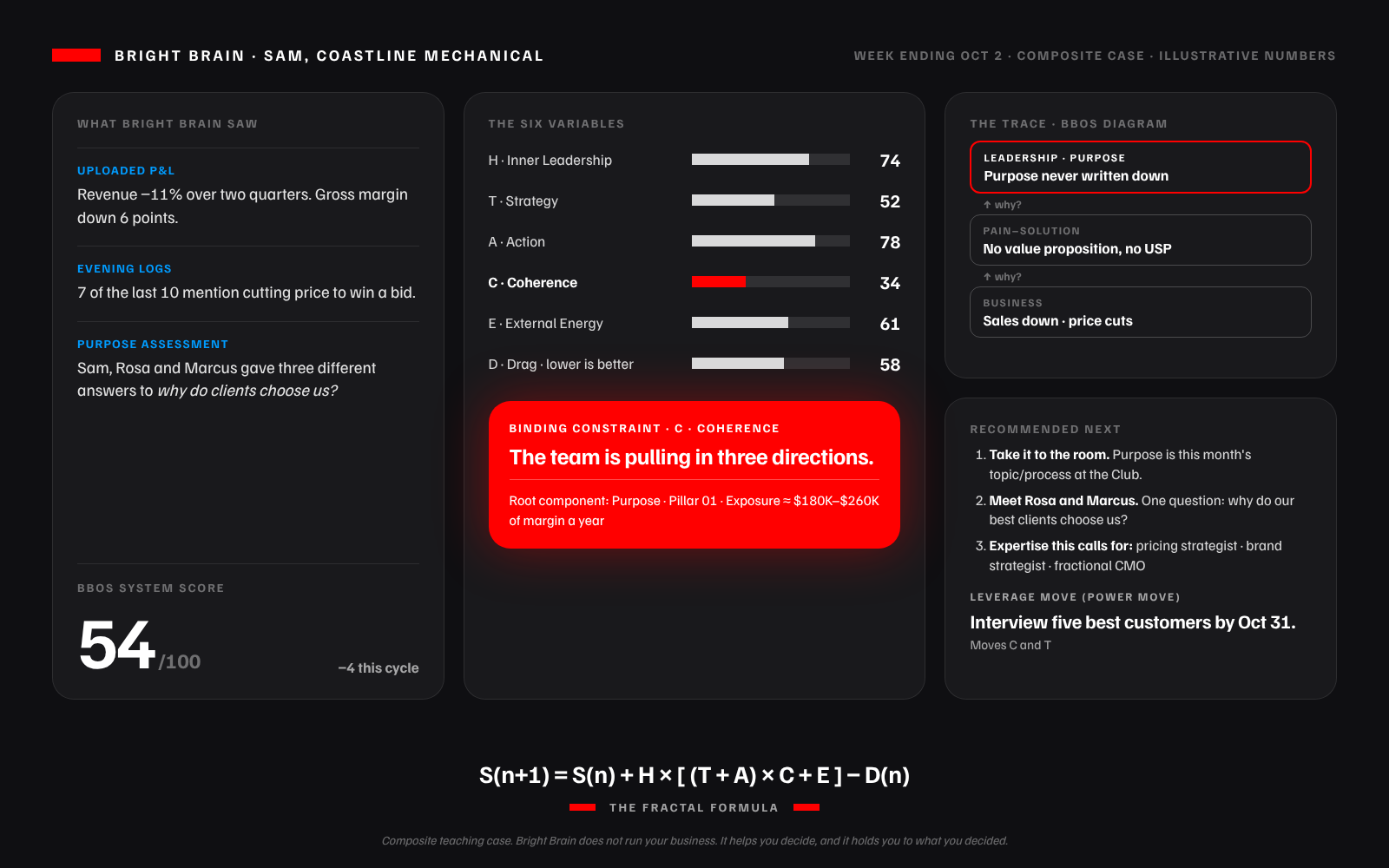
It didn’t tell Sam how to run his company. It told him where to look and what to do next: bring it to the Club, where Purpose was already this month’s topic/process; sit down with Rosa and Marcus around that one question; and name the kind of expertise the constraint calls for. Bright Brain does not run your business. It helps you decide, and it holds you to what you decided. The decision itself still needed people who knew the business, in a room.
Sam started the truck and drove home. The next morning he put the Club meeting on the calendar, and a meeting with Rosa and Marcus right after it.
The traceIn the room: three whys, from the symptom to the root
At the Club, nobody started with the fix. We started with the symptom and kept asking why, on the Business Structure Diagram, the map of the Bright Business Operating System. It has three verticals: Leadership, Pain–Solution and Business.
Why 1 · The symptom. Sales are down. That lives at the bottom of the diagram, in the activities, the team and the objectives. It is where everyone looks, and where nothing gets solved.
Why 2 · The chain of constraints. Why are sales down? Because sales has no message beyond price. Why? Because marketing has no differentiator. Why? Because nobody in the company can say, in one sentence, which pain Coastline solves better than anyone, and for whom. No clear pain, no value proposition, no unique selling proposition. The friction between departments was not a people issue. It was a missing foundation.
Why 3 · The root cause. Why does nobody know the value proposition? Because it was never written down. It lived in Sam. As the business grew, the business side got more complex than the technical side, and Sam became the bottleneck. You can’t delegate a why you have never named.
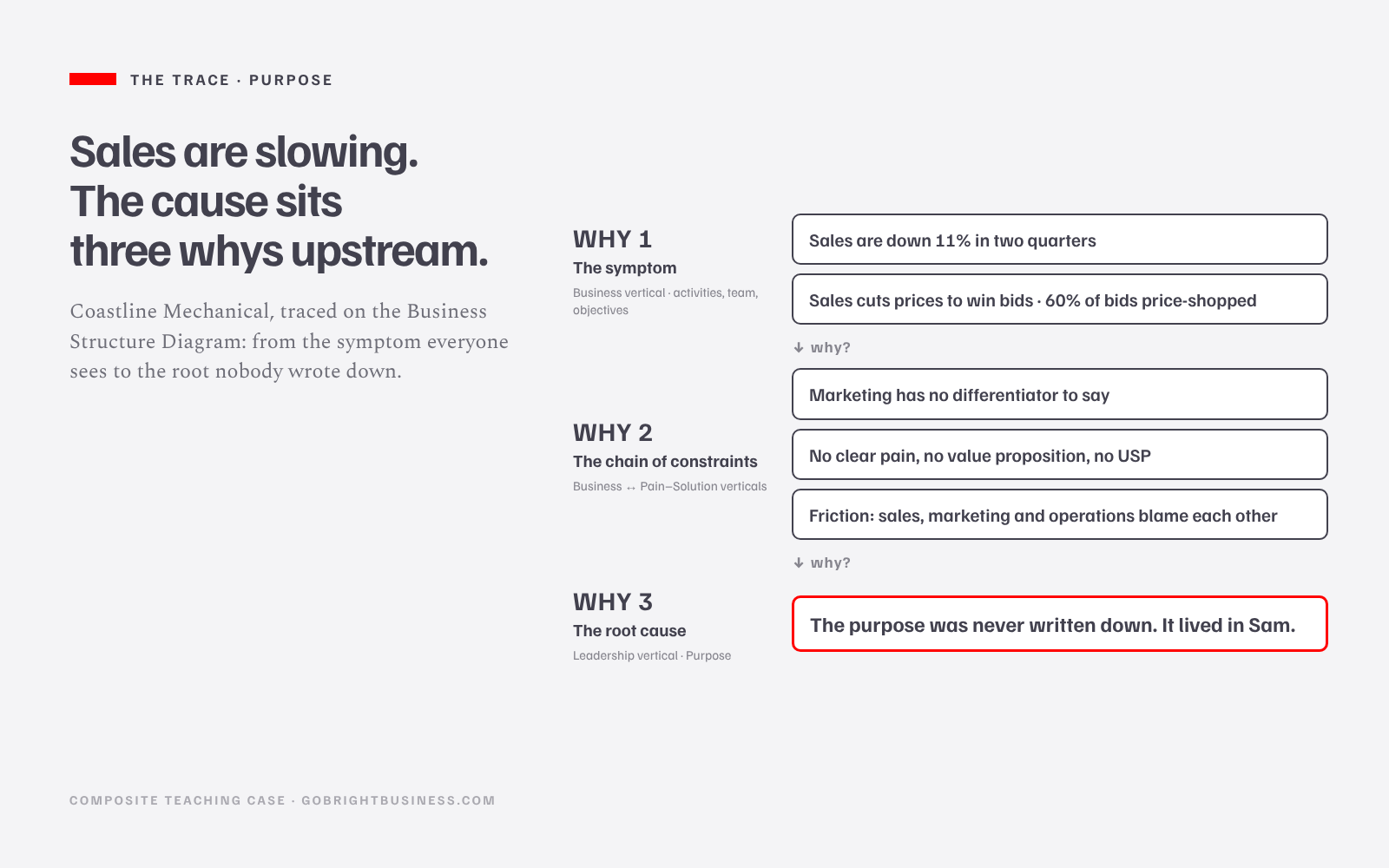
Sam looked at the red box at the top of the diagram for a long time. Then he said it out loud: “It was never Marcus. It was never marketing. I never told them why we exist.”
Across the table, a restaurant owner in the Club said what Sam’s customers had been thinking for fourteen years:
Sam’s customers were never buying his price. They were buying the fact that their doors stayed open.
Want to trace your own business the way Sam did? Every second Tuesday we run Bright Business Discovery: 30 minutes online, one topic/process, and your questions. This month: Purpose, on Tuesday, October 13, 9:30 AM PT.
The methodPurpose, worked on the 2×2 Human-Centered Matrix
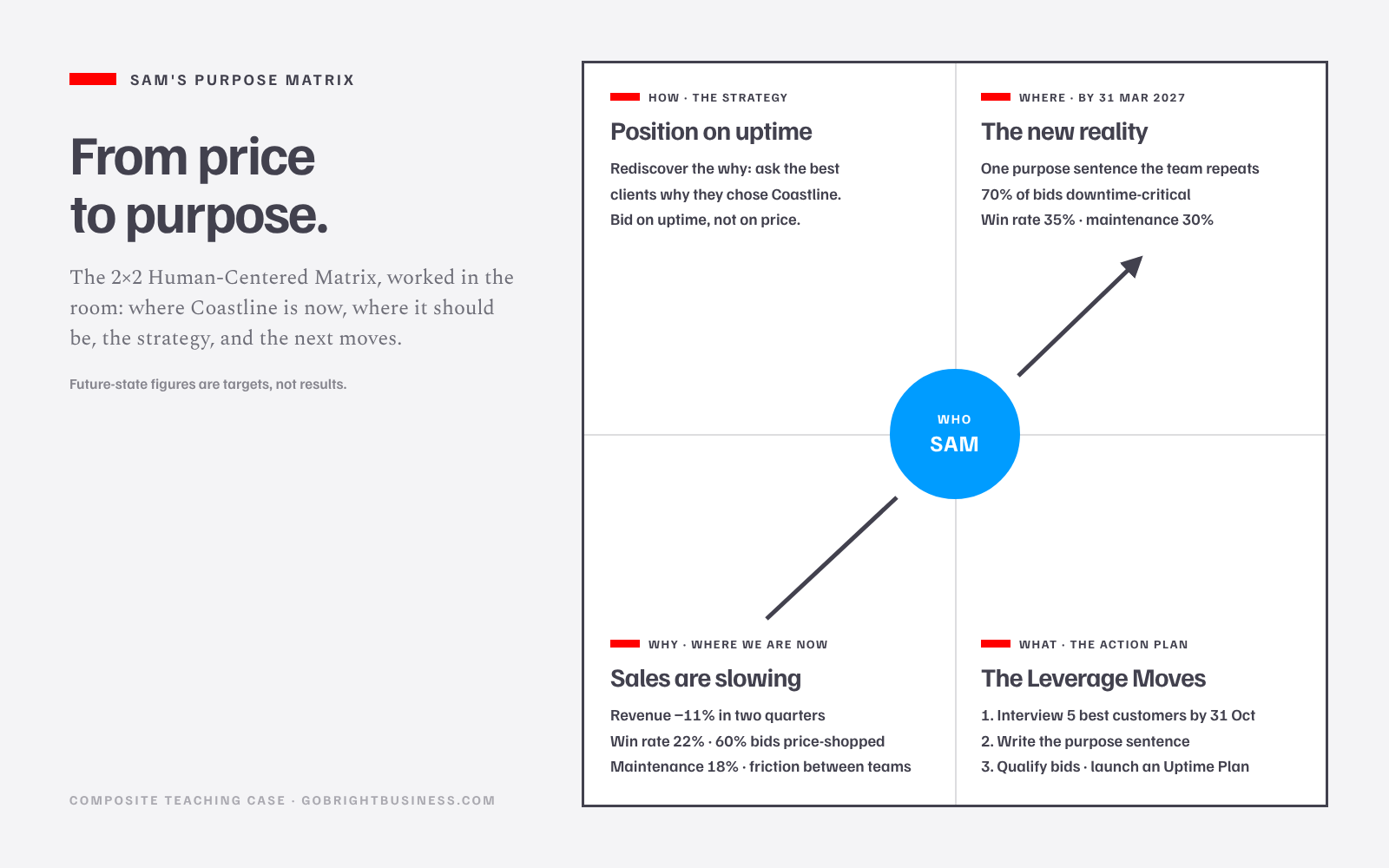
Once the root is clear, we work it on the 2×2 Human-Centered Matrix: four questions in a fixed order, with the owner at the center.
WHY · Where are we now, and why leave? Sales are falling, margins are thin, and the departments are fighting. If the why behind the business stays unnamed, everything downstream keeps breaking, all the way to the sales numbers. And the people who carry that cost are the whole team, and their families. The pressure to fix it is real.
WHERE · What is the new reality? More sales, yes. But above all, a different company: people who know what they do and why, no friction between departments, a team that is proud of what it stands for. In numbers, by 31 March 2027: one purpose sentence the whole team can repeat, 70% of bids going to customers for whom downtime is critical, a win rate of 35%, and maintenance at 30% of revenue.
HOW · What is the strategy? Rediscover the why instead of inventing it. Go back to the past and ask: Why was I able to start this business? Why was I able to grow it? Why did the early clients choose us, and why do the best ones stay? The answers are already out there, in the clients.
WHAT · What is the action plan?
- Interview five of the best customers by 31 October: why they chose Coastline, why they stay, what it would cost them if Coastline disappeared. This was Sam’s Leverage Move for the month.
- Write the purpose in one sentence, with Rosa and Marcus in the room.
- Turn it into a value proposition marketing can say and sales can bid on.
- Qualify bids: go after the customers who can’t afford a day of downtime, and stop chasing the ones who only compare prices.
- Build the offer around it: a maintenance plan sold on uptime, not on visits.
WHO · Who owns it? Sam first. The matrix always puts a person at the center, because a strategy nobody owns is a wish.
The turnWhat the customers said
The interviews changed the conversation. Sam’s best customers were restaurants, clinics, and businesses that serve first responders: places that cannot close for a day when the air conditioning fails. They didn’t choose Coastline because it was cheap. They chose it because Sam picked up the phone at night and got them running again.
Sam was never really in the business of bidding on HVAC jobs. He was in the business of keeping small businesses open. The sentence the team wrote together:
“We keep San Diego businesses open, so a failed system never costs our customers a day.”
That one sentence gave marketing its message, gave sales a reason to bid on quality instead of price, and gave Rosa’s team a standard to work to.
Before and afterWhat changed when the why was named
| Before | After | |
|---|---|---|
| How they bid | On price; about 60% of bids price-shopped | On uptime, for customers who can’t afford downtime (target: 70% of bids) |
| Win rate | 22% | 4 of the first 14 qualified bids won, 29% (target: 35%) |
| Recurring revenue | Maintenance 18% of revenue | Uptime Plan launched; 9 contracts in the first four weeks (target: 30% of revenue) |
| Team | Sales blames marketing, operations absorbs bad jobs | One sentence everyone can repeat, and a reason to be proud of the work |
Composite teaching case. “After” figures are illustrative of the pattern; targets are marked.
Retention went up because customers were sold what they actually valued. Subscriptions replaced one-off repairs. Margins came back because the bids no longer had to be the cheapest. And the next constraint showed up, as it always does: only two technicians could cover 24/7. That is a better challenge to have, and it is November’s topic/process.
Neither half would have been enough alone. Bright Brain named the constraint from Sam’s own data, early, before the margins were gone. The room turned it into a decision: peers who had faced the same pricing pressure, experts who knew which question to ask next, and a Leverage Move Sam had to report on four weeks later. That is how a Bright Business member makes the call: with the data, and with the people.
The evidencePurpose is not a slogan. It shows up in growth.
In a Harvard Business Review Analytic Services survey of 474 executives, 58% of companies with a clearly articulated and understood purpose reported growth of 10% or more over three years, compared with 42% of companies that had not prioritized purpose.2 Deloitte’s 2020 Global Marketing Trends report puts it more strongly: purpose-driven companies gain more market share and grow on average three times faster than their competitors, with higher employee and customer satisfaction.3
Purpose is where strategy starts. From it you build your positioning, from your positioning your offer, and from your offer the marketing that brings in quality leads and the sales that close at the right price.
Your turnFive questions to find the why behind your business
- Why did I start this business, and what did I want it to make possible?
- Why did my first clients choose me, when they had other options?
- Why do my best clients stay?
- What would they lose if we closed tomorrow?
- Who pays the price, inside the company and at home, if we keep going without an answer?
Then write one sentence: We [do what] for [whom], so [the outcome that matters to them]. If your sales lead, your operations manager and your marketing person would each write a different sentence, you have found your root cause.
Bring your sentence. Pick the room that fits you.
Your first Club visit is complimentary.
Florin Diumea, Bright Business · Stay Bright.
Sources
- Michael V. Marn, Eric V. Roegner and Craig C. Zawada, “The power of pricing”, McKinsey Quarterly (February 2003).
- Harvard Business Review Analytic Services, sponsored by EY Beacon Institute, “The Business Case for Purpose” (2015).
- Deloitte Insights, 2020 Global Marketing Trends, “Purpose is everything”.